The early-career job hunt often feels like an impossible paradox: You need experience to get hired, but you need someone to hire you to get experience.
When application portals demand 1–2 years of relevant work history for entry-level roles, sending a standard one-page resume filled with high school honors and coursework lists rarely cuts through the noise. Recruiters don't expect college students to have a decade of corporate tenure, but they do want concrete proof of capability.
Building a dedicated online portfolio bridges this gap. It shifts the conversation from "Where have you worked?" to "What can you build, write, or solve?"
Here is how you can build a credible, recruiter-ready portfolio before graduating—even with zero formal job experience.
1. Audit Your "Hidden" Experience
You do not need a corporate paycheck to demonstrate value. College coursework and extracurricular activities produce dozens of tangible work samples that many students leave buried on Google Drive.
Extract assets from these five overlooked areas:
Capstone & Semester Projects: Group assignments, research papers, marketing plans, or software builds. Document your individual contribution, the problem tackled, and the final grade or outcome.
Hackathons & Competitions: Any hackathon, case competition, or design sprint you entered—even if you didn’t win—demonstrates deadline-driven problem solving and teamwork.
Club & Society Leadership: Managing a student club’s social channels, organizing campus events, or handling budgeting involves real-world operational and marketing skills.
Independent Projects & Self-Study: A mobile app built over a weekend, a published Medium essay, an open-source GitHub contribution, or a personal design redesign.
Volunteer Work & Pro Bono Help: Helping a local business set up their social media, redesigning a family friend's website, or tutoring classmates.
2. Structure Projects as Case Studies (The "STAR" Method)
A portfolio is not a photo gallery; it is a problem-solving showcase. Instead of merely posting a screenshot or a link to a file, format each project using a simplified STAR framework:
Situation: What was the assignment or problem?
(e.g., "Our engineering capstone required designing an automated plant watering monitor using limited microcontrollers.")
Task: What was your specific responsibility?
(e.g., "I handled the sensor calibration, circuit soldering, and data logging logic.")
Action: What tools, languages, or frameworks did you use?
(e.g., "Programmed in C++ on an Arduino Nano with an ambient light sensor and soil moisture probe.")
Result: What was the outcome?
(e.g., "Delivered working prototype on schedule, achieving 98% moisture accuracy and an 'A' grade.")
Using this structure proves to recruiters that you understand the business context of your work, not just the mechanical steps.
3. Keep Your Essential Portfolio Pages Frictionless
Hiring managers spend an average of under 30 seconds evaluating an entry-level candidate's web presence. Structure your portfolio for rapid scanning:
A Focused Headline: State your direction clearly. Instead of "Student at XYZ University," use "Aspiring Data Analyst | Python, SQL, Tableau | Class of 2026."
3–4 Curated Projects: Quality beats quantity. Three deeply documented projects with clear takeaways are significantly more persuasive than ten superficial links.
A Verified Skills Section: Group your skills logically (e.g., Programming Languages, Design Tools, Core Methodologies) rather than presenting an unsorted cloud of buzzwords.
Frictionless Contact Information: Include your direct email address and a downloadable vCard so recruiters can contact you immediately without completing cumbersome third-party web forms.
4. Connect Your Portfolio to Your ATS Resume
A live portfolio link demonstrates proof of work, but applicant tracking systems (ATS) still require a standardized resume file to pass through automated screening filters.
If your portfolio URL sits on an unformatted resume filled with text boxes, columns, and graphics, automated parsers may reject the file before a recruiter ever clicks your link.
To maximize your application rate:
Keep your submitted resume in an ATS-friendly, single-column layout.
Place your portfolio link (
[mydigifolio.com/yourname](https://mydigifolio.com/yourname)) prominently in the header alongside your name and email. Match the bullet points on your resume directly with the project titles highlighted on your portfolio for instant consistency
.
5. Launch in Under 10 Minutes with MyDigiFolio
Designing a website from scratch, buying custom domains, and maintaining hosting servers takes time away from preparing for technical interviews and campus exams.
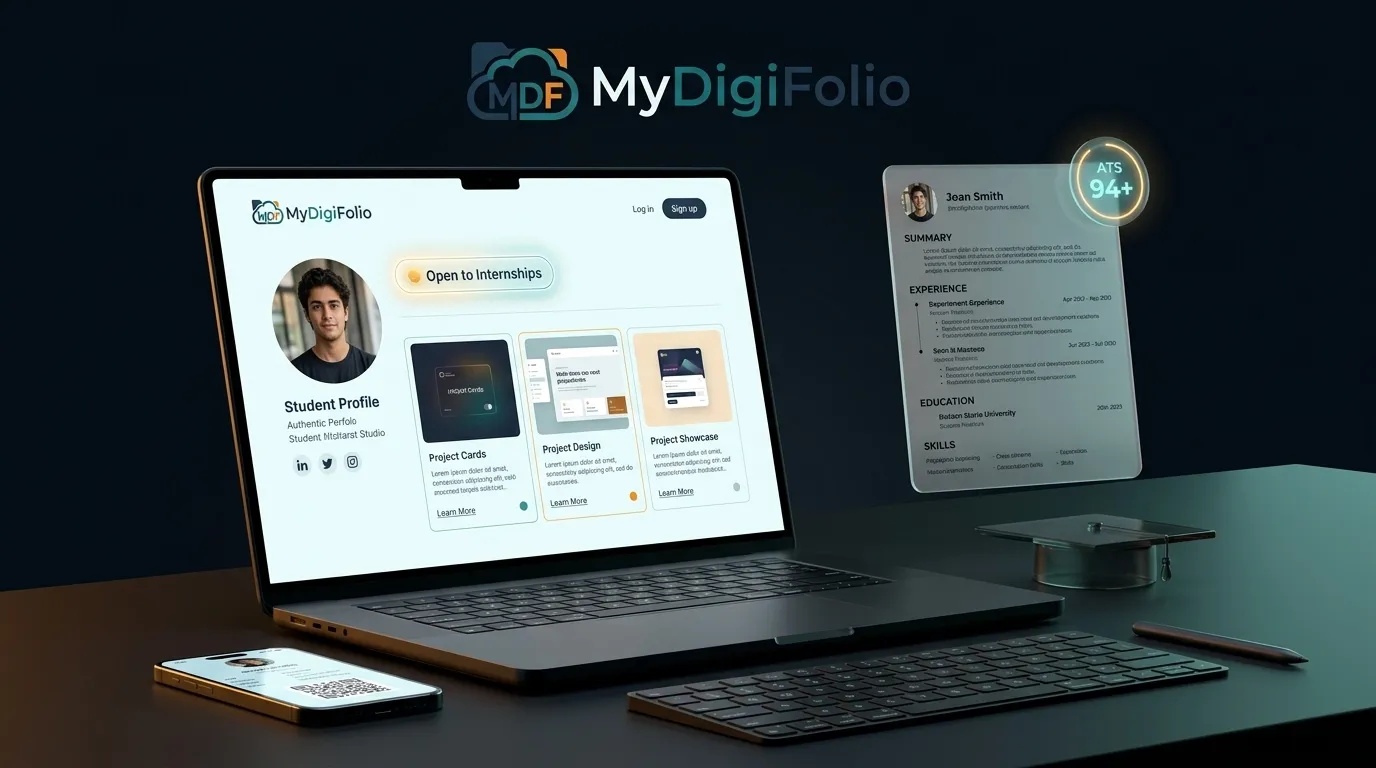
With MyDigiFolio, you can enter your project details, academic milestones, and skills once to automatically generate all your essential career deliverables from one dashboard
Your Personal Web Showcase: A clean link (
[mydigifolio.com/yourname](https://mydigifolio.com/yourname)) to showcase your projects and bio without writing code. ATS-Scored Resumes: Standardized PDF and DOCX downloads engineered to pass recruiter screening algorithms
. Scannable Digital vCard: A custom QR code you can save to your phone lockscreen to instantly share contact details at career fairs and meetups
. HTML Email Signature: A branded sign-off for your job applications and networking emails
.
It is 100% free forever for students, requires no credit card, and takes less than 10 minutes to set up