BUSINESS
Oracle’s Larry Ellison Dismisses ‘SaaS Apocalypse’ Fears, Predicts Zero-Training AI Industry Suites
MyDigiFolio Editors
3 min read
BUSINESS
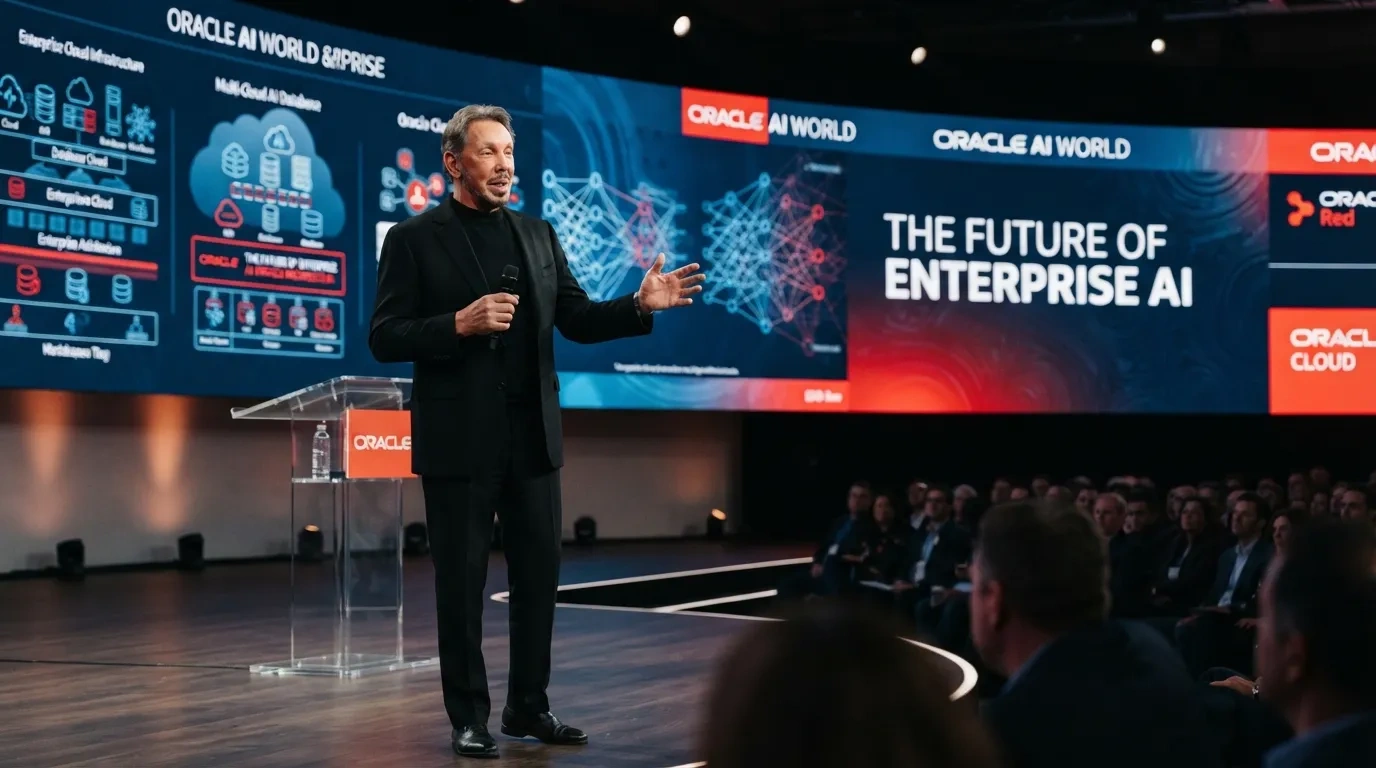
Oracle CTO Larry Ellison pushed back against fears of a "SaaS apocalypse" at Oracle AI World, dismissing theories that companies will abandon enterprise software vendors to build custom tools with AI. Ellison argued that artificial intelligence enables vendors to finally deliver complete, vertical-specific suites that require zero user training and activate without lengthy multi-year rollouts. Starting with healthcare, he asserted that conversational interfaces will make complex software screens obsolete.
Oracle executive chairman and chief technology officer Larry Ellison has dismissed Wall Street and Silicon Valley concerns that generative AI will spark a "SaaS apocalypse"—the notion that enterprises will stop buying commercial software-as-a-service subscriptions and use autonomous coding agents to build proprietary internal stacks instead.
Speaking at Oracle AI World, Ellison argued that AI will not destroy enterprise software vendors; instead, it will finally allow them to build complete, industry-specific application suites that require no formal user training and deploy without multi-million-dollar, multi-year installation contracts.
The Unfinished Software Problem Ellison pointed out that for decades, enterprise software vendors have sold half-baked solutions that forced customers to carry massive IT overhead:
The Customization Tax: Hospitals, commercial lenders, and hotel chains have historically had to contract systems integrators or write proprietary code to stitch together disparate commercial applications.
Vertical Integration via AI: With generative models handling logic and schema discovery, vendors can finally ship turnkey platforms tailored to the exact workflows of specific verticals.
Healthcare as the Benchmark: Oracle is developing end-to-end suites for banking, retail, hospitality, and public sector operations, but chose to deploy Oracle Health first because clinical medicine represents the world's most intricate operational environment.
"Because of AI for the first time, we as an industry, the software industry, can actually finish the applications if we start doing them industry by industry. There should be no training required to use any of these applications." — Larry Ellison, CTO & Executive Chairman, Oracle
Killing Complex User Interfaces Recounting a hospital visit where multiple specialists struggled across fragmented desktop screens to locate an X-ray of his son's broken leg, Ellison argued that modern graphical user interfaces (GUIs) are fundamentally obsolete:
Conversational Navigation: Users should be able to ask for what they want in natural language and receive it immediately, while the AI navigates backend tables and records invisibly.
Instant Activation: Instead of classic ERP rollouts that drag on for two years, Oracle Health’s modular AI architecture discovers existing clinical records automatically and layers over them instantly.
Drug Breakthroughs and the 'Value-Added' Tax Pivot Ellison tied Oracle's aggressive health focus to personal loss, recalling his mother's death from cancer while he was a college student. He predicted AI-driven clinical trials and molecular discovery will enter a "golden age," forecasting that most cancers could be effectively cured within the next decade.
Addressing workforce displacement, Ellison dismissed claims that AI will replace all human workers, comparing it to aviation autopilots that assist human pilots rather than eliminating them entirely. However, acknowledging disruptions in transport and logistics, Ellison called on governments to adapt fiscal policy: shifting tax structures away from human labor toward taxing the economic value added by autonomous robotics, which he suggested could ultimately finance a model of "universal high income."

ET HospitalityWorld (The Economic Times) · 5 days ago
Harajuku Tokyo Cafe has raised $3 million in Pre-Series A funding led by Zero W to bankroll a ten-store rollout and open centralized commiss...
Business & Startup · 5 days ago
OpenAI has adjusted its valuation expectations down by $150 billion to $1.25 trillion as it nears the finish line of a massive $30 billion p...
Business & Startup · 5 days ago
British banking giant Barclays is eliminating roughly 5,000 roles—about 5% of its global workforce—to trim fixed overhead as artificial inte...
From MyDigiFolio
One profile. Resume, vCard, portfolio, and email signatures — all generated in 3 minutes.
Build your page — freeWe use essential cookies for login and preferences, and optional cookies for analytics. Privacy policy.