AI & TECH
US-China AI Race Risks Financial Shocks and Mass Layoffs Over Next Three Years: S&P Global
MyDigiFolio Editors
3 min read
AI & TECH
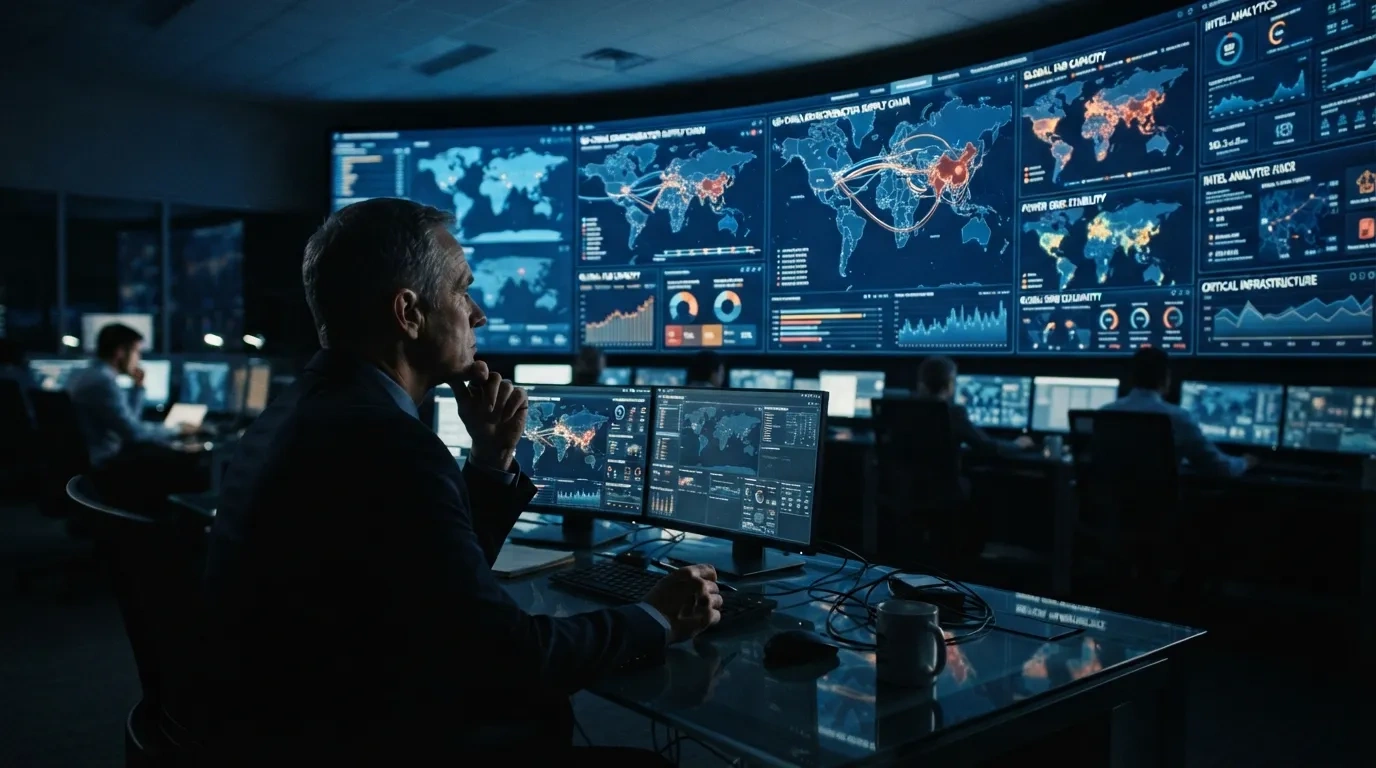
The geopolitical AI rivalry between the United States and China is headed for potential financial turbulence, with S&P Global Ratings warning of an "AI bubble burst" and sector-wide mass layoffs over the next three years. Assessing the competition across five foundational layers—power, semiconductors, infrastructure, models, and applications—the agency finds China leading in energy capacity and centralized state coordination, while the US dominates in private venture capital and frontier hardware access. However, because American AI capex is market-funded, unmet ROI expectations risk triggerin
The accelerating battle for global artificial intelligence supremacy between the United States and China has entered a high-stakes phase characterized by contrasting operational paradigms: China's centralized, state-directed industrial model versus the United States' private, market-funded venture ecosystem.
According to a comprehensive risk assessment by S&P Global Ratings, this bilateral contest faces substantial economic headwinds over the next three years. Chief among these threats are a potential "AI bubble burst" and widespread workforce reductions, driven by misallocated capital, lagging return-on-investment (ROI), and mounting infrastructure debt.
Evaluating the Five Ecosystem Layers S&P Global evaluated both superpowers across five structural layers of the artificial intelligence stack—power, chips, infrastructure, models, and applications—concluding that China leads in two, trails in two, and shares mutual bottlenecks in one:
Power Grid & Energy (China Leads): China maintains a clear, expanding advantage in power generation and grid distribution. Supported by long-term planning frameworks like the East Data, West Compute initiative, China can deploy energy to remote compute corridors with lower bureaucratic friction.
Semiconductor Fabrication (US Leads): US export controls and advanced equipment restrictions continue to handicap China's access to leading-edge lithography, though these constraints are rapidly forcing China to build out self-reliant, end-to-end domestic silicon supply chains.
Data Center Infrastructure (Divergent Bottlenecks): Both nations face structural infrastructure hurdles. US hyperscalers are constrained by public-market demands for immediate profitability and ROI, while China faces the risk of debt-driven overcapacity due to aggressive local government subsidies.
Foundation Models (Parity & Coexistence): S&P Global notes that neither the US proprietary model nor China’s open-source framework is guaranteed to dominate; both architectures are likely to coexist as enterprise buyers select models based on targeted price-to-performance tiers.
Applications (China Accelerates): China holds a competitive edge in rapid commercial productization and speed-to-market across its massive domestic consumer and industrial ecosystem.
"China shows advantages in government support and national coordination while the US hyperscalers plan to invest vastly larger sums and have unimpeded access to cutting-edge technology... A potential 'AI bubble burst' and 'mass layoffs' are the most likely risks over the next three years." — S&P Global Ratings
Spillover Risks to Global Markets and APAC Because the US AI boom is primarily underwritten by private equity, venture capital, and public debt markets, an investment correction could ripple far beyond Silicon Valley:
Financial Contagion: Substantial write-downs or bankruptcies among cash-burning AI startups would directly hit debt-issuing banks, enterprise equity holders, and global institutional investors.
S&P Global cautions that if China successfully maneuvers through foreign chip restrictions to achieve end-to-end sovereignty, its state-subsidized operational model could establish an insurmountable cost barrier, making it exceptionally difficult for both developed and emerging economies to compete in downstream AI software.
The Indian Express · 1 day ago
Nvidia’s board has reportedly approached Arm Holdings CEO Rene Haas as a prospective replacement for longtime chief Jensen Huang, who steppe...
The Economic Times · 1 week ago
Indian generative AI startup Sarvam AI has appointed Sashikumar Sreedharan, former Managing Director of Google Cloud India and Microsoft Ind...
The Economic Times · 1 week ago
India's conversational AI sector—valued at $500–550 million with a projected addressable opportunity of $4 billion over the coming decade (g...
From MyDigiFolio
One profile. Resume, vCard, portfolio, and email signatures — all generated in 3 minutes.
Build your page — freeWe use essential cookies for login and preferences, and optional cookies for analytics. Privacy policy.