Your student profile.
Where potential gets noticed.
Recruiters spend 7 seconds on a resume. Without years of experience, you need projects, internships, and proof of learning velocity to stand out. 67% of employers now hire based on skills and portfolios, not just degrees. Here's how to build a student profile that lands your first internship or graduate role.
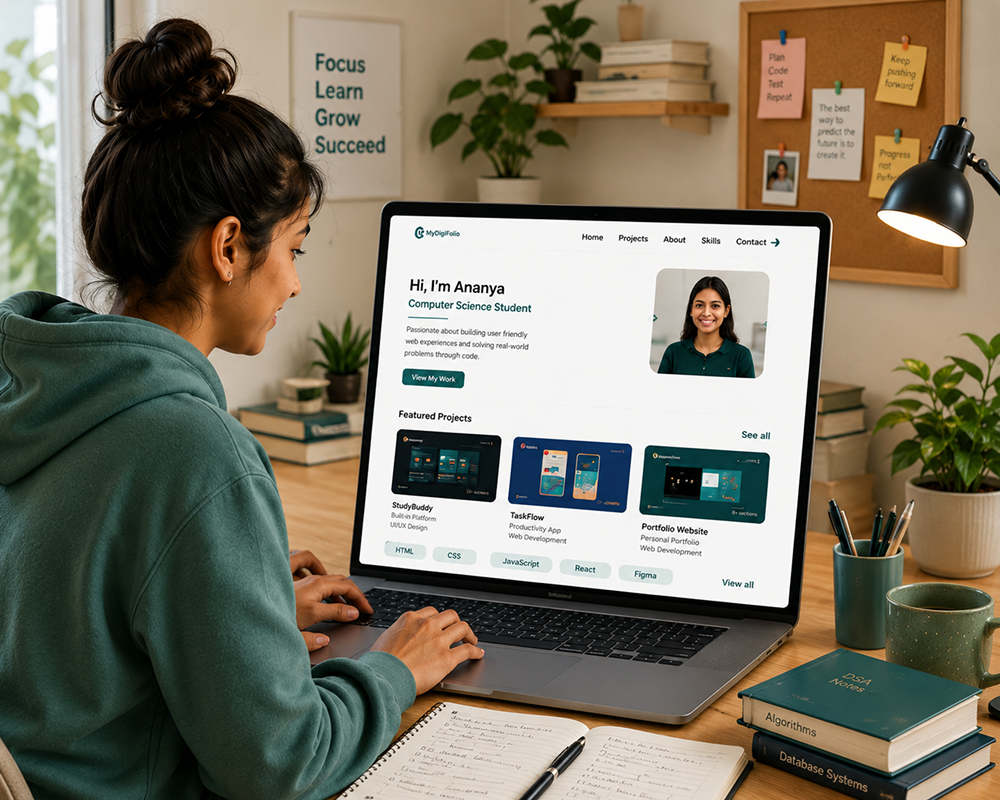


Projects that prove you can build
Without work experience, your projects are your resume. Show code, process, and what you learned.
AI Study Buddy — ML-Powered Tutor
Built a full-stack web app that uses OpenAI API to generate personalized study plans, quiz questions, and explanations based on uploaded course materials. Trained a custom fine-tuned model on 500+ past exam papers. 200+ active users at my university. Open source with 340 GitHub stars.
Distributed Systems — Fault-Tolerant Key-Value Store
Implemented a Raft consensus algorithm from scratch in Go. Handles leader election, log replication, and network partitions. Benchmarked against etcd — achieved 85% throughput with 3 nodes. Wrote 40-page technical report on consistency trade-offs. Grade: A.
Campus Safety App — 2nd Place, 120 teams
Built a real-time safety app with live location sharing, emergency alerts, and AI-powered route optimization to avoid high-crime areas. Integrated with campus police API. Led team of 4 developers. Pitched to judges and won $2,500 prize. App adopted by student government for pilot.
Education & credentials
Your degree is the foundation. Certifications and coursework show you're proactive about learning beyond the classroom.
How to build experience as a student
No internship? No problem. Here's how to close the experience gap before you graduate.
Build Real Projects
Don't just follow tutorials — solve real problems. Build apps you'd actually use, contribute to open source, or clone complex products (not To-Do lists). Deploy them, share them, and write about what you learned.
Get Certified
AWS, Google, Meta, and freeCodeCamp certifications prove self-motivation. They're especially valuable if you're targeting a field not fully covered by your degree (cloud, data, cybersecurity).
Hack & Compete
Hackathons, coding competitions (LeetCode, Kaggle), and case comps build skills under pressure. They also create portfolio pieces, team experience, and networking opportunities — sometimes leading directly to job offers.
Intern Early & Often
Start applying freshman year. Even unpaid or part-time internships build credibility. Each internship makes the next one easier to get. By senior year, you'll have 2–3 experiences that separate you from the "no experience" pile.
Tools you're learning
Showcase your technical toolkit. Even "learning" proficiency signals growth mindset to recruiters.
Your journey so far
Every step counts. Show internships, part-time work, volunteering, and leadership — not just formal jobs.
What professors and mentors say
Recommendations from professors, TAs, and internship managers carry weight when you lack full-time experience.
Common questions for students
Everything you need to know about building a student profile that gets you hired.
A student portfolio needs 3–5 projects that demonstrate different skills — not 10 variations of the same thing. Include at least one full-stack project, one that shows algorithmic thinking, and one that solves a real problem you care about. For each project, explain the problem, your approach, technical decisions, and what you learned. Include GitHub links, live demos, and screenshots. Course projects count if you went beyond requirements. Hackathon projects count if they're polished. Side projects count most of all.
Start with what you have. Personal projects, open-source contributions, and coursework can substitute for work experience if they're substantial. Apply broadly — 50+ applications is normal for your first role. Leverage your university's career center, alumni network, and professor connections. Attend career fairs and company info sessions. Cold outreach on LinkedIn to alumni at target companies works better than you'd expect. Your first internship is the hardest to get; each one after gets easier.
Include it if it's 3.5 or above. Omit it if it's below 3.0. For GPAs between 3.0–3.5, include it only if you're targeting companies that explicitly require it (some consulting firms and investment banks). In tech, GPA matters far less than projects and internships. If you have strong projects and experience, your GPA becomes irrelevant. If your GPA is low but trending up, mention your major GPA or recent semester GPA instead.
Prioritize certifications that complement your degree and target role. For cloud: AWS Cloud Practitioner (free for students via AWS Educate), then Solutions Architect Associate. For data: Google Data Analytics Certificate, IBM Data Science Professional. For web: Meta Front-End Developer, freeCodeCamp certifications. Avoid paying for expensive bootcamp certificates unless they include job placement support. Free certifications from reputable companies (Google, Meta, AWS, Microsoft) carry more weight than paid ones from unknown providers.
Depth beats breadth. Every CS student takes data structures — but how many built a distributed key-value store from scratch? Every business student studies marketing — but how many ran a real campaign for a student org? Find one area where you can go deeper than the syllabus. Contribute to open source, start a side project, write technical blog posts, or teach others. The students who get hired are those who showed initiative beyond assignments. Your profile should answer: "What did you do that wasn't required?"
MyDigiFolio provides student-friendly portfolio templates that guide you through showcasing projects, coursework, internships, and certifications — even with limited experience. Your profile links your resume, GitHub, LinkedIn, and project demos in one shareable URL. Built-in project templates help you structure your write-ups to highlight problem-solving, not just features. The platform is optimized for how campus recruiters and hiring managers review student candidates: they scan for project quality first, then check for evidence of learning velocity and initiative.
Your first role starts with proof of potential
Recruiters review 200+ student resumes per opening. MyDigiFolio helps you build the project-rich, certification-backed, recommendation-supported profile that proves you can learn fast and deliver — even without years of experience.